
72%
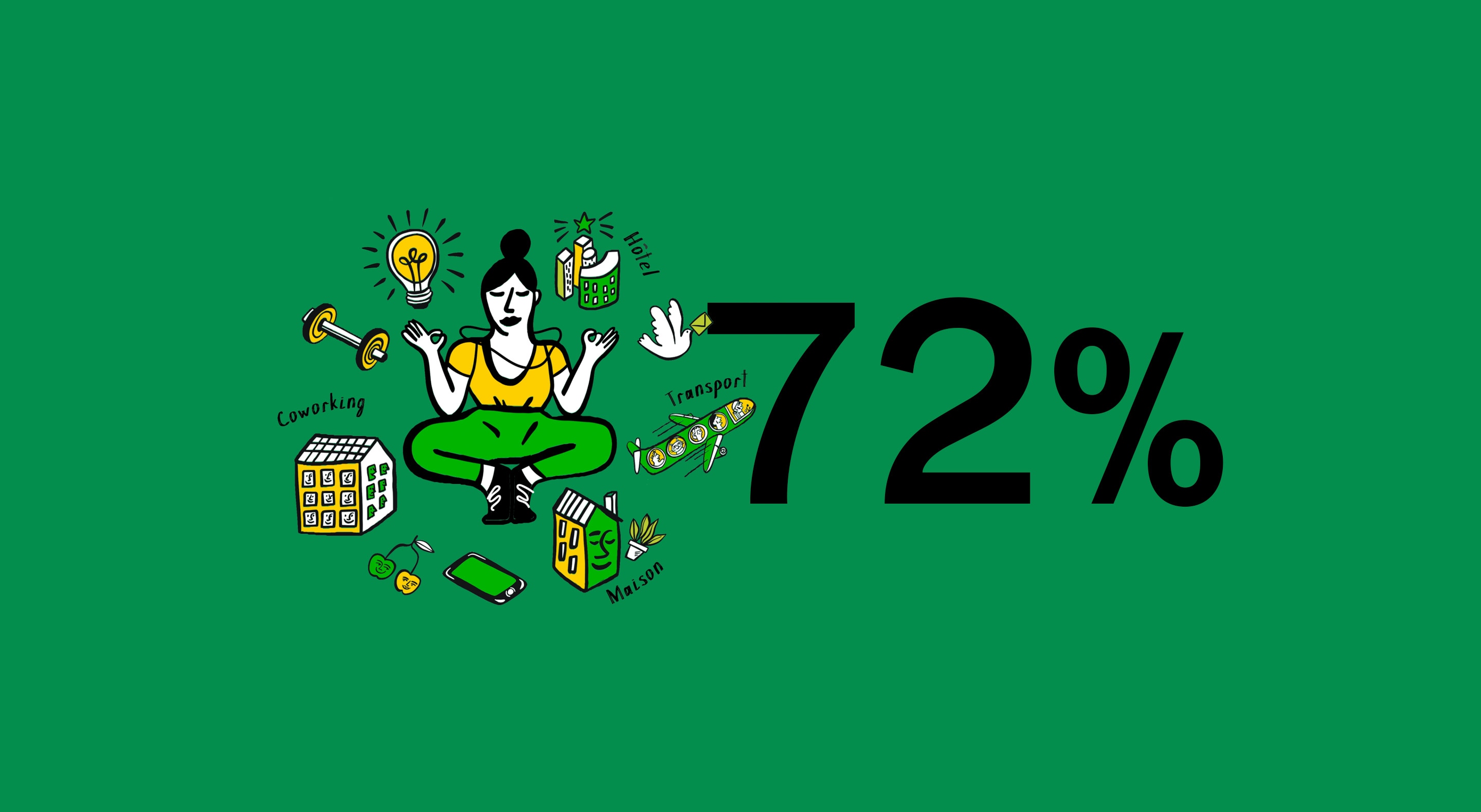
72% of employees believe that to make them want to come to the office, their company must offer them better working spaces than at home.
Will we all be nomads in the future?
Indeed, work done outside the office is now an integral part of our habits for 72% of us, according to the latest Actineo barometer (compared to 53% in 2019). Still, this desire for freedom doesn’t mean the end of offices, since 56% of respondents continue to work there exclusively. Many company headquarters have already integrated this need for freedom and socializing into the workplace and are committed to opening up, “greening”, decompartmentalizing, and creating themed spaces so that well-being and work can become “words that go so well together”.
Will this be a cure for stress and “quiet quitting” *?
Remote work has changed everything
It’s not the end of offices! 56% of respondents work exclusively in person or at the office each month.
Nevertheless, work done outside of offices is growing: 72% in 2023 compared to 53% in 2019.
It’s a form of emancipation from the office, due to remote work, first of all, but also due to the ever-growing use of other spaces.
The “despatialization” of work is underway, with a desire for greater freedom to organize one’s work both in terms of space and time.
Returning to the office to see others
42% of respondents work from home every month.
With competition from the home space, offices have to reinvent themselves.
Social relationships and friendliness are the heart of what attracts people to the office.
Desirable office spaces highlight this attraction with access to more informal relational spaces.
Quality of life at work is declining
The proportion of office workers who are satisfied with their quality of life at work (QLW) has gone down 10 points since 2019, to 77%.
The feeling of stress at work has increased, while employees are also feeling less supported by their companies in terms of “well-being”.
There’s a strong temptation to disengage, notably through “quiet quitting”, which has taken off among those under 35 years of age.
The design of premises can impact QLW
Coming just after the role of the employer, the quality and availability of appropriate workspaces play a major part in the feeling of being happy at work.
Employees have stated the importance of workspaces for their health, well-being, relationships with colleagues, and efficiency.
And yet, ¼ of employees working at the office estimate that their workspaces are not adapted to their needs.
Want to know more? Discover the full survey here